
How Ketamine Works for Treatment-Resistant Depression: New Brain Imaging Study Reveals the Mechanism
Ketamine has become one of the most important new treatments for people with treatment-resistant depression (TRD). For some patients who have tried multiple antidepressants without success, ketamine can produce relief within hours or days—something traditional medications rarely achieve.
But for years, researchers have been trying to answer a basic question:
What is ketamine actually doing in the brain to produce such rapid antidepressant effects?
A new study published in Molecular Psychiatry in March 2026 provides some of the clearest evidence yet. Using advanced brain imaging, scientists were able to observe how ketamine changes key receptors involved in how brain cells communicate.
The findings help explain why ketamine works differently from conventional antidepressants—and why it may be especially helpful for people whose depression hasn’t responded to other treatments.
A Different Approach to Treating Depression
Most traditional antidepressants work by influencing neurotransmitters like serotonin or norepinephrine. These medications can be effective, but they often take weeks to produce noticeable improvement, and many patients never respond fully.
Ketamine works through a different system in the brain: the glutamate system, which plays a central role in how neurons communicate and adapt.
Glutamate signaling is closely tied to synaptic plasticity, the brain’s ability to strengthen or weaken connections between neurons. Healthy brain function depends on these flexible connections, which allow us to learn, adapt, and regulate emotions.
Increasingly, researchers believe depression may involve disruptions in this communication network.
Watching Ketamine’s Effects in the Living Brain
In the new study, researchers at Yokohama City University used a specialized PET imaging tracer called [¹¹C]K-2. This tracer allows scientists to measure the activity of AMPA receptors, a key component of the glutamate system.
AMPA receptors help regulate how strongly neurons communicate with each other. They are thought to play a major role in brain plasticity and mood regulation.
The study included:
34 patients with treatment-resistant depression
49 healthy control participants
Participants with depression received two weeks of ketamine treatment or placebo. PET brain scans were performed before treatment and again afterward to observe changes in AMPA receptor activity.
What Researchers Found
Before treatment, patients with treatment-resistant depression showed disrupted AMPA receptor patterns across multiple brain regions compared with healthy individuals.
After ketamine treatment, however, patients who improved showed clear changes in these receptors.
Researchers observed:
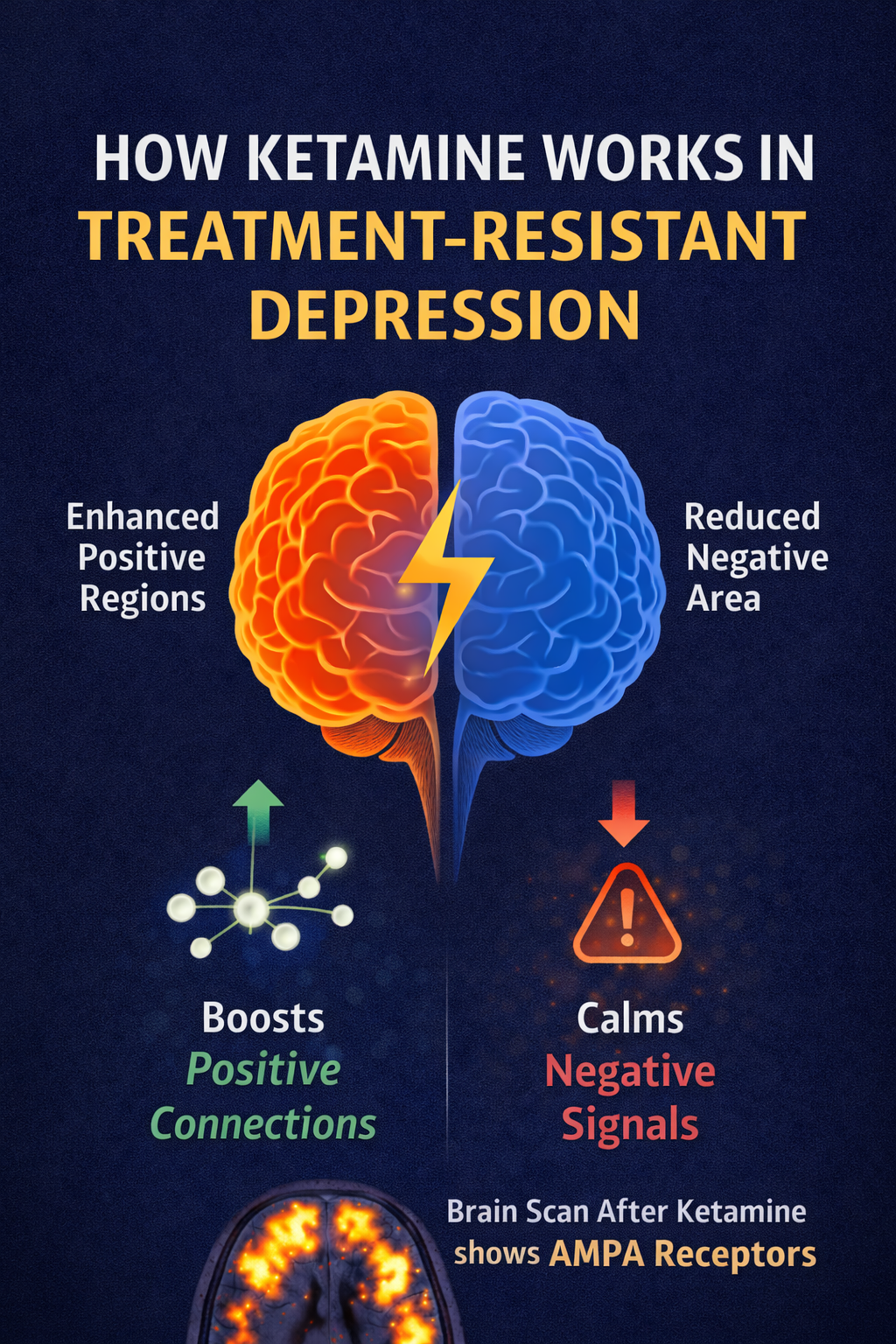
Increased AMPA receptor activity in parts of the cortex
These areas are involved in mood regulation, emotional processing, and higher-level thinking. Increased receptor activity suggests improved neural communication and stronger synaptic connections.
Reduced activity in the habenula
The habenula is a small brain structure involved in processing negative outcomes and disappointment. In depression, this region can become overactive, reinforcing negative emotional patterns.
Ketamine appeared to reduce this overactivity.
A “Reset” of Brain Communication
The study suggests ketamine may work by rebalancing neural circuits involved in mood and emotion.
Instead of simply boosting one neurotransmitter, ketamine appears to:
strengthen communication in brain networks responsible for mood regulation
reduce activity in regions associated with negative emotional signaling
promote synaptic plasticity, allowing the brain to form healthier patterns
This may explain why some patients experience a rapid shift in mood, motivation, and perspective after treatment.
What This Means for Patients
For people struggling with treatment-resistant depression, these findings reinforce what clinicians have observed in practice: ketamine represents a different class of antidepressant therapy.
Understanding the mechanism behind ketamine’s effects could also help researchers develop new treatments that target the same brain systems.
In the future, brain imaging tools like those used in this study may even help doctors predict which patients are most likely to benefit from ketamine therapy, allowing for more personalized care.
The Bottom Line
Depression is increasingly understood not just as a chemical imbalance, but as a disorder involving disrupted brain communication networks.
Ketamine appears to help by restoring balance within those networks—enhancing healthy signaling while quieting circuits that reinforce negative emotional patterns.
For patients with treatment-resistant depression, that shift can open the door to meaningful and sometimes rapid relief.